How to Make a Simple Amplifier Circuit at Home Easily Circuit Diagram A Simple Audio Amplifier with LM741 Op-amp is a basic audio amplifier circuit designed to amplify weak audio signals and drive a speaker. The LM741 is used as the primary amplification component, while the other components like the BC547 transistor and capacitors provide further amplification and stability to the circuit.

Only a couple resistors and capacitors are needed to make a simple audio amplifier. The chip has functions for gain control and bass boost, and it can also be turned into an oscillator capable of outputting sine waves or square waves. The LM386 is a type of operational amplifier (Op-Amp). Operational amplifiers have a basic task.
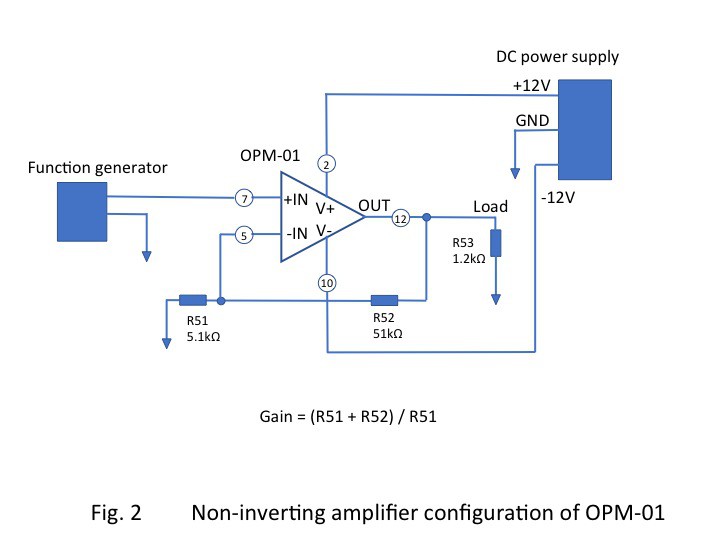
OpAmp Basics : 11 Steps (with Pictures) Circuit Diagram
The identical 741 op-amp can also be used in a circuit which does not depend on an external signal source (AC mains hum). The 741 op-amp is used in a high-frequency oscillator circuit that operates around its peak frequency in this very unique proximity sensor device described below. The internal feedback capacitor of the 741 op-amp restricts
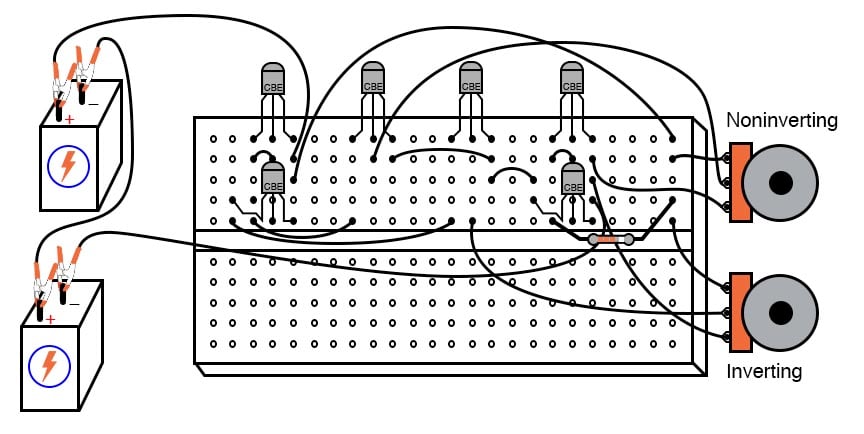
An op-amp has two inputs, an inverting terminal (labeled „-") and a non-inverting terminal (labeled „+"). And has a single output. The first input is called inverting because the output voltage is inverse of the voltage applied at the inverting input, times the gain of the amplifier circuit.If we apply the signal to the non-inverting input we get the same signal on the output, times gain.
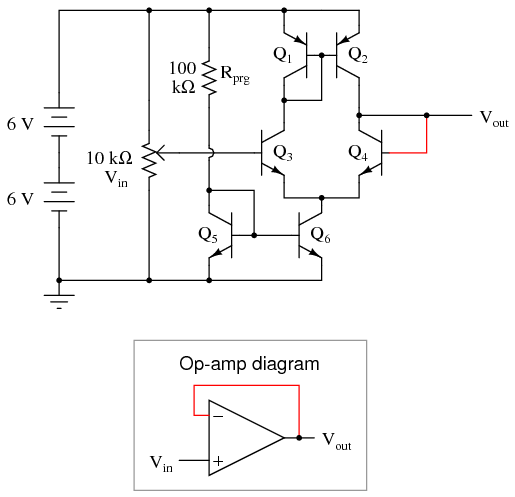
Ultimate Guide to Op Circuit Diagram
Offset voltage: The DC voltage that, when applied between the input pins, will cause a DC output voltage of zero. If both inputs were grounded, the output voltage of the op-amp would not be zero. Slew rate: The time taken for the output to change for a given input.Specified as V/mS. Equivalent input noise voltage: The noise performance of the op-amp. An ideal voltage source is placed in series

A simple voltage follower. The input can vary from -12 to +12, starting at +2.5 V and seeing how far positive and negative the op amp will recognize. The LM741 would not recognize an input voltage lower than 1.8 V or higher than 4.4 V. The LM741 is used in many schools because it is a good example of the problems with op amps.
